
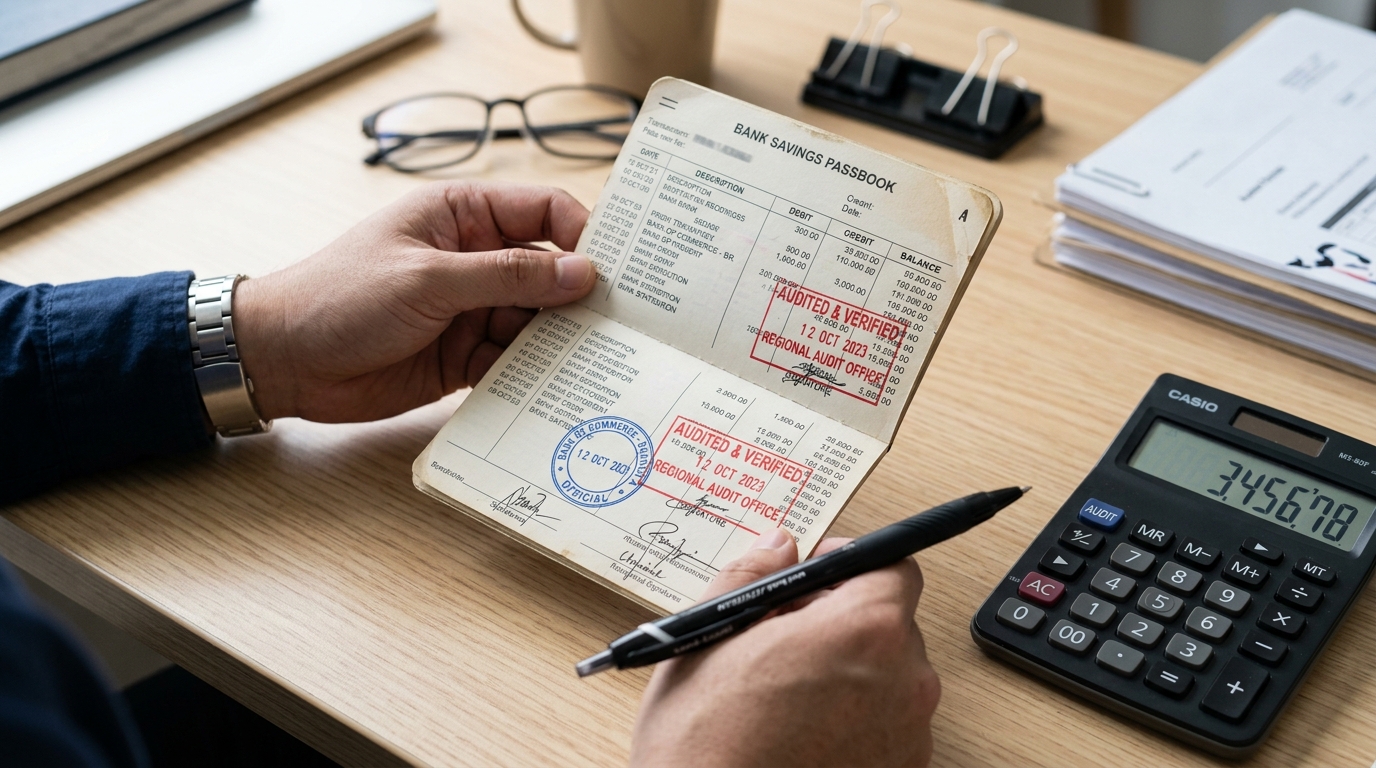
Financial sufficiency is one of the most closely examined parts of any Schengen visa application. Visa officers do not look only at your final balance; they inspect your transaction history over three to six months, match salary deposits with your payslips, and check for large unexplained deposits. If your account fails this audit, your visa will be refused under Ground 3 ("insufficient means of subsistence for the duration of the intended stay").
A Ground 3 refusal is recorded in the Visa Information System (VIS) shared by all 29 Schengen countries. Preventing a refusal through clear, properly stamped documents is far easier than reapplying after a rejection.
This guide outlines how to prepare bank statements that satisfy French, German, Italian, and Swiss consulates for your VFS Global submission in India.
What is "Means of Subsistence" Under Schengen Visa Code Article 14?
Article 14 of the Schengen Visa Code requires applicants to demonstrate sufficient means of subsistence for their stay, including accommodation, daily living costs, and return travel. Each member state sets its own daily baseline.
Daily Balance Benchmarks by Schengen Country
Official daily thresholds used by visa officers include:
- France: €120/day (no hotel prepaid), €65/day (hotel prepaid), €32.25/day (staying with an invited host).
- Germany: €45/day minimum daily balance.
- Italy: Flat band scale (approx €270 fixed for stays up to 5 days, plus €45/day for longer trips).
- Switzerland: 100 CHF (approx. €105)/day.
These amounts represent minimum requirements exclusive of international flights. Maintaining balances comfortably above these levels strengthens your file.
Why Transaction Continuity Matters More Than Final Balance
Visa officers evaluate your account over 3 to 6 months. A regular pattern of salary credits and gradual savings shows stability. A flat account showing a large deposit right before your appointment suggests borrowed money to inflate the balance.
If your average monthly balance is ₹40,000, but your final day balance is ₹3,50,000 due to an unexplained transfer, officers rely on the average balance for their assessment.
Required Financial Documents Checklist for VFS Global Submission
Primary Documents: Stamped Bank Statements and Payslips
- Bank statements covering last 3 to 6 months.
- Physical bank stamp and signature on every page. Digital PDF prints are routinely rejected.
- Last 3 months salary slips matching credited net salary in bank statements.
- HR employment confirmation or salary certificate.
Secondary Documents: ITR Filings and Supplementary Assets
Submit Income Tax Returns (ITR-V) for the last 2 assessment years to verify reported income. Fixed Deposits (FDs) or Mutual Funds can be included as secondary assets, but cannot replace your active savings account statement.
If you do not have ITR filings, check our guide on Schengen visa alternative financial documents without ITR.
Ground 3 Refusals: How Financial Inconsistencies Cause Rejections
Unexplained Cash Deposits and Borrowed Funds
Sudden large deposits made within 30 days of submission are assumed to be borrowed money unless supported by clear sourcing documents (property sale deed, PF withdrawal, bonus letter).
Without supporting documents, officers disregard recent deposits and base their evaluation on your historical balance. Read our guide on how to handle lump sum deposits for Schengen visa.
Critical Mistakes to Avoid in Your Bank Statements
- Submitting unstamped PDF printouts downloaded from online banking.
- Dormant accounts showing sudden activity right before the visa appointment.
- Mixing personal and business accounts for salaried applicants.
Expert Consular Auditor Insights
Salary Matching: Officers match net salary from payslips with bank deposits. In case of deductions, the actual credited balance is used for liquidity evaluation.
Borrowed Funds Window: Any large transfer within 30 days of submission needs clear source documentation.
Before applying, review the general Schengen Visa Tourism Requirements and verify fees on our Schengen Visa Fees Guide page.
Frequently Asked Questions
Q1: Can I show credit card limits as proof of bank balance?
No. Credit limits are not liquid funds. You must demonstrate actual savings held in a bank account.
Q2: Does my bank statement need to be stamped on every page?
Yes. Most Schengen consulates require physical stamps and signatures on every page.
Q3: What is the minimum bank balance required for a 10-day trip?
A safe balance is ₹2,00,000 to ₹2,50,000 per applicant to cover flights, hotels, daily living, and insurance.
Q4: Can I use Fixed Deposits as primary proof of funds?
No. FDs are investments. Your primary proof must be an active savings account statement.
Q5: What if my trip is sponsored by a family member?
Submit a signed sponsorship affidavit, the sponsor's stamped bank statements, and their ITR filings.
Q6: Are joint bank accounts accepted?
Yes, provided the applicant is a primary or secondary holder.
Q7: How many months of bank statements should I submit?
Submit 3 to 6 months of statements. 6 months is recommended for self-employed applicants.
Q8: Why did I get a Ground 3 refusal when I had enough money?
Ground 3 refusals are triggered by unstamped statements, sudden unexplained deposits, or low average balances.
Q9: Can I submit statements from two different bank accounts?
Yes, provided both statements carry physical bank stamps and signatures on every page.
Q10: Do self-employed applicants need company bank statements?
Yes. Self-employed applicants must submit both personal savings and business current account statements.
Author
ExpressVisa Schengen Editorial