
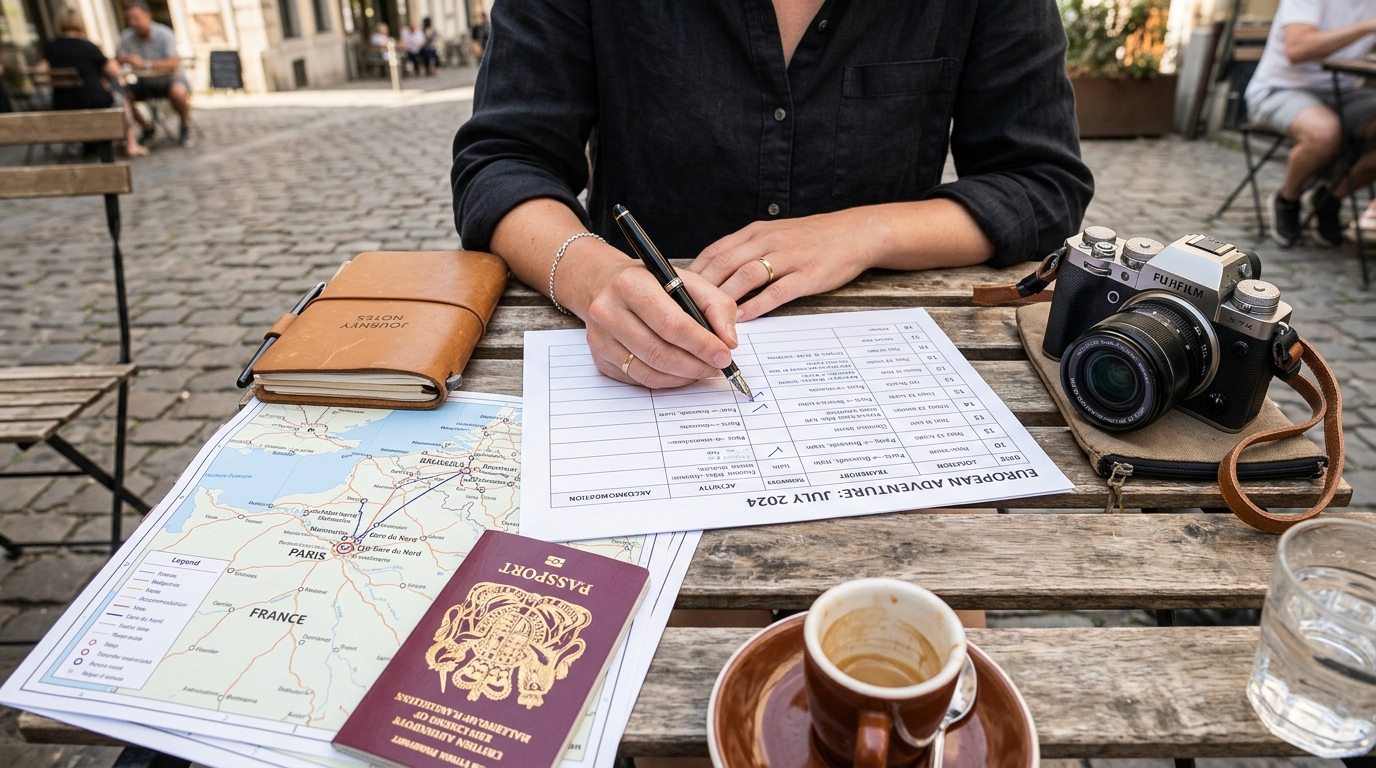
Submitting a travel plan that makes no geographic sense is the fastest way to trigger a Ground 2 refusal on a Schengen visa application. Visa officers at French, German, and Italian embassies check details carefully; claiming to wake up in Paris, visit Rome for lunch, and sleep in Berlin on the same day will cause your application to be rejected immediately as fabricated.
A day-by-day travel itinerary grid is the central timeline of your application. It is a table that tells the visa officer where you will be, what you will do, where you will stay, and how you will travel between cities for every day of your trip. When this grid matches your flight reservations, hotel vouchers, and train tickets, your application is consistent. Any mismatch will cause your file to be flagged and refused.
This guide outlines how to build a clear, consistent itinerary grid that meets the requirements of Article 14 of the Schengen Visa Code for your VFS Global submission in India.
The Purpose of the Day-by-Day Itinerary Grid in Your Schengen Visa File
Why Schengen Visa Code Article 14 Demands Chronological Proof
Article 14 of the Schengen Visa Code requires applicants to justify the purpose and conditions of their stay. The itinerary grid is the practical proof of those conditions. It turns a vague statement like "I am visiting Europe for tourism" into a clear, date-specific plan that the visa officer can verify against your bookings.
Without this grid, your application is just a pile of disconnected papers. The itinerary grid binds them into a single, logical plan. It is embedded directly in your cover letter, which serves as the executive summary of your file. If you have not yet written your cover letter, you can use our Schengen visa cover letter guide.
The Cross-Reference Test: Matching Your Grid to Hotel Booking Vouchers and Flight Reservations
During file review, the visa officer scans the itinerary grid and selects a random date—for example, October 14th. The officer then looks for the hotel voucher corresponding to the night of October 14th in your document stack. If the grid says you are in Brussels, but the hotel voucher says you are in Amsterdam, your file will be flagged for inconsistency.
This check applies to every day of your trip. Your flight reservation must match your entry and exit dates. Your train tickets must match your transit days. Your hotel bookings must cover every single night without gaps. A single mismatch can compromise your entire application.
Step-by-Step: How to Design a Legitimate Schengen Travel Itinerary Grid
Step 1: Define Your Main Destination and Consular Selection
Under Schengen rules, you must apply to the embassy of the country where you spend the highest number of nights. If you are spending 5 nights in France, 3 in Belgium, and 2 in Germany, you must apply to the French consulate.
Your grid must make this calculation visually clear. When the officer counts the nights per country in your table, the result must match the embassy of your VFS appointment. If it does not, your file will be rejected at the counter.
Step 2: Lock Your First Entry Point and Repatriation Date
Your grid must begin with the date you land in the Schengen Area and end with the date you depart. These dates must match your flight reservations exactly.
The first entry point is where you initially enter Schengen territory. If you fly from Delhi to Paris with a layover in Frankfurt, your first entry point is Frankfurt, where you clear immigration. However, your main destination remains France if you spend the most nights there. State both clearly in your grid.
The final row of your grid must show your departure city, flight number, and return destination to prove you have a non-negotiable exit date from Europe.
Step 3: Map Internal Transit with Train Tickets and Regional Flights
For multi-country trips, specify how you travel between cities. Vague entries like "travel to next city" are not acceptable. The officer needs to see the mode of transport and booking references.
Acceptable transit entries include:
- Cross-border train tickets (e.g., Eurostar from Paris to Brussels, booking reference TH-48291)
- Regional flight bookings (e.g., EasyJet flight from Paris to Rome)
- Bus bookings (e.g., FlixBus from Munich to Salzburg, confirmation FX-77120)
- Rental car details (pickup and drop-off dates and locations)
Every border crossing in your grid must be backed by a corresponding booking document in your file.
Step 4: Structure the Daily Grid with Five Columns
Use a clean, five-column table format. Each row must represent one calendar day. Do not combine multiple days, and do not leave any date gaps.
The Grid Template Format: Sample 3-Day Itinerary
Below is a sample showing a transition between Paris and Brussels:
- 12 Oct 2026 | Paris, France | Arrival. Check-in. | Hotel Le Marais, 14 Rue de Rivoli, Paris | Flight AF 225, Delhi to Paris CDG (PNR: XJ4KLM)
- 13 Oct 2026 | Paris, France | Sightseeing: Louvre Museum & Seine. | Hotel Le Marais, 14 Rue de Rivoli, Paris | Metro Day Pass
- 14 Oct 2026 | Brussels, Belgium | Morning departure. Afternoon sightseeing. | Hotel Amigo, Rue de l'Amigo, Brussels | Eurostar Train 9352, Paris to Brussels (Ref: TH-48291)
Ensure the accommodation column lists the full hotel name and street address. Activity descriptions should be concise and realistic. Writing seven attractions in a single day makes the plan look fabricated.
Common Itinerary Errors That Trigger Ground 2 Refusals
Consular Shopping and Main Destination Violations
If you apply at the Italian consulate but your grid shows 8 nights in France and only 2 nights in Italy, the officer will identify this as "visa shopping" and reject your file, instructing you to apply to France.
Geographical Impossibility and Unrealistic Pacing
Visa officers understand European geography. A grid showing you in Rome on the morning of October 15th and in Amsterdam that evening, with no flight booking to explain the 1,300-kilometer gap, is an immediate red flag.
Unbooked Nights and Missing Accommodation Proof
Every night must be accounted for and backed by a booking voucher. A single night with no accommodation or overnight transit listed will create suspicion, leading to a Ground 2 rejection.
Expert Consular Auditor Insights: What Officers Verify First
The Booking Verification Match is Non-Negotiable. Officers will pick a random date from your grid and search for the matching hotel voucher. Ensure every single row aligns with your documentation.
Verifiable Flight Bookings. Consulates verify PNR codes directly with airlines. If you submit a dummy flight booking that is inactive or cancelled by the time they check, your application will be refused for fraud, which can lead to a future travel ban.
Pacing Reveals Authenticity. Write your grid the way a real traveler would plan a trip. Do not list dozens of attractions per day. The officer wants to see a realistic plan.
If you are matching your travel dates with approved leave, refer to our No Objection Certificate NOC template for Schengen visa page.
Frequently Asked Questions
Q1: Do I need to buy flight tickets before applying?
No. Embassies advise against buying non-refundable tickets. Submit an active, reserved flight itinerary with a PNR code instead.
Q2: What is the main destination in a multi-country itinerary?
It is the country where you spend the highest number of nights. If nights are equal, it is the country you enter first.
Q3: Can I change my itinerary after receiving the visa?
Minor changes are fine, but completely changing your main country after approval can lead to your visa being cancelled at border checks.
Q4: How detailed does the daily activity description need to be?
Keep it simple. Writing "Sightseeing in Munich, visiting Marienplatz" is sufficient detail for the consulate.
Q5: What should I show for internal travel between Schengen countries?
Submit booked cross-border train tickets, regional flight confirmations, or bus bookings. Include the operator name and booking references.
Q6: Do I need to show hotel bookings for every single night?
Yes. Every single night from entry to departure must be covered by a valid hotel booking or sponsorship host document.
Q7: What if I am taking an overnight train or flight?
Write "Overnight transit" in the accommodation column and attach your train booking or flight ticket as proof.
Q8: Can I use free-cancellation booking websites for my hotels?
Yes, reservations from major platforms are accepted, provided they show your name and are active when audited.
Q9: What is a Ground 2 visa refusal?
A Ground 2 refusal means the officer found your travel purpose or itinerary conditions unreliable, often due to date mismatches or night gaps.
Q10: Should my travel itinerary dates match my travel insurance coverage?
Yes. Your travel insurance policy must cover the entire duration of your trip, from your arrival date to your departure date back to India.
Author
ExpressVisa Schengen Editorial