
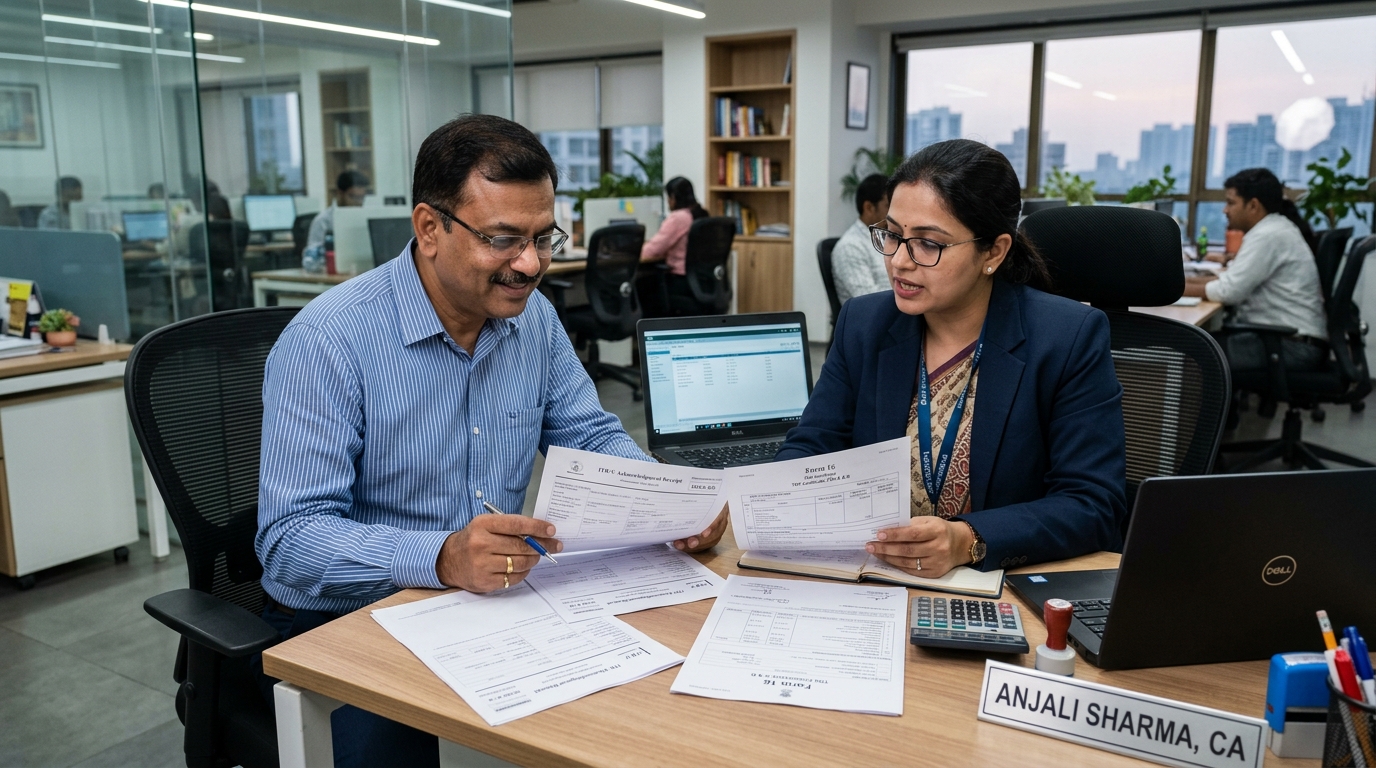
Bank statements show cash flow and salary slips show monthly pay, but Income Tax Returns (ITR) provide independent proof of declared income and tax compliance. When reviewing a Schengen visa file, visa officers rely on ITR filings to verify that your reported income matches your actual earnings.
Filed with the Income Tax Department and acknowledged via an ITR-V receipt, your tax returns serve as anchor proof of your financial standing. Discrepancies between your reported ITR income, salary slips, Form 16, and bank credits can raise doubts about your financial profile and cause a Ground 3 refusal.
This guide covers required tax forms for salaried workers, business owners, and freelancers, rules on assessment years, and key filing errors to avoid.
Why Schengen Embassies Demand Income Tax Return (ITR) Filings
Independent Verification of Financial Credibility
An ITR is an official government-verified record filed on the Income Tax e-Filing portal. Visa officers view ITR filings as reliable proof of income. Large discrepancies between reported tax income and monthly bank deposits require clear explanation.
The Cross-Reference Protocol: ITR, Form 16, and Bank Statements
Officers cross-check gross income on ITR-V receipts with Form 16 figures and credited bank balances. Numbers should align consistently after accounting for standard statutory deductions (PF, tax).
How Many Years of ITR Are Required for a Schengen Visa?
The Standard Two-Year Benchmark
The standard requirement across French, German, Italian, and Swiss consulates is ITR-V acknowledgment receipts for the last 2 Assessment Years (AY). Submitting two years establishes financial continuity over time.
Tax Assessment Year vs. Financial Year
Financial Year (FY) is the year income is earned. Assessment Year (AY) is the following year when taxes are filed. Always submit the official ITR-V receipts indicating the required Assessment Years.
Required Tax Documents by Applicant Category
Salaried Applicants
- ITR-V acknowledgment receipts for the last 2 Assessment Years.
- Form 16 (Part A and Part B) for the last 2 financial years.
- Salary slips for the last 3 months matching bank deposits.
Self-Employed & Business Owners
- ITR-3 or ITR-4 filings for the last 2 Assessment Years with ITR-V receipts.
- CA-certified Computation of Income sheets.
- Audited Profit & Loss Statements and Balance Sheets (if turnover requires audit).
- GST registration and recent return summaries.
Freelancers and Consultants
- ITR-V receipts for last 2 Assessment Years (ITR-4 / ITR-3).
- CA-certified professional income computation.
- Active client contracts, invoices, and bank statements showing client payments.
If you lack ITR filings due to low taxable income, review our guide on how to apply for Schengen visa without ITR.
Common ITR Filing Errors That Trigger Scrutiny
Freshly Filed Back-Dated ITRs
Filing ITRs for two missed years all at once right before your visa appointment is a major red flag. Officers check the "Date of Filing" on ITR-V receipts. Rushed filings can lead to Ground 3 rejections.
Nil Returns Contradicting Bank Activity
Filing a Nil return (zero tax) while maintaining high bank deposits creates a contradiction that suggests unreported income or unverified funds.
Form 16 and ITR Income Mismatches
Ensure the salary reported on your ITR under "Income from Salary" matches the gross salary figure on Form 16 Part B.
Expert Consular Auditor Insights
Filing Date Verification: Officers check the filing date first. Returns filed months in advance reflect routine compliance, whereas last-minute filings invite extra scrutiny.
CA Endorsement: For business owners and freelancers, CA-certified computation sheets significantly increase file credibility.
To understand how tax filings interlink with liquid fund audits, read our Schengen visa bank statement auditing guide.
Frequently Asked Questions
Q1: Is ITR compulsory for a Schengen visa application from India?
Yes. ITR is a standard financial document used to verify income stability and compliance.
Q2: How many years of ITR do I need to submit?
Submit ITR-V acknowledgment receipts for the last 2 Assessment Years.
Q3: Is Form 16 enough if I do not have my ITR filing?
Form 16 is strong proof, but attaching the actual ITR-V receipt alongside Form 16 is recommended.
Q4: What if I filed a Nil ITR with zero taxable income?
Nil returns are accepted if income is below taxable limits, provided bank statements reflect adequate savings.
Q5: Can I submit ITR filed just days before my visa appointment?
Technically yes, but back-dated returns filed right before submission raise suspicion.
Q6: Which ITR form should salaried employees submit?
Salaried employees submit ITR-1 or ITR-2 along with the corresponding ITR-V receipt.
Q7: What tax documents do self-employed business owners need?
Submit ITR-3/ITR-4, CA-certified Computation of Income, audited P&L sheets, and GST returns.
Q8: What if I lost my ITR-V acknowledgment copy?
Download official PDF copies from incometax.gov.in under "View Filed Returns".
Q9: Do dependents need to submit ITR?
No. Dependents submit their sponsor's ITR filings alongside a sponsorship affidavit.
Q10: What is the difference between Financial Year and Assessment Year?
Financial Year is when income is earned; Assessment Year is the following year when taxes are filed.
Author
ExpressVisa Schengen Editorial